zkSYS and DA commands
Start on zkSYS Genesis
Genesis is the public zkSYS Edgechain testnet. You can read it immediately over JSON-RPC. To try an application with a wallet, start at the zkSYS Portal.
- Choose the network. In the Portal, select zkSYS Tanenbaum and connect your EVM wallet. For manual setup, use the Genesis RPC and chain ID 57057 below. Chainlist calls the same network zkTanenbaum Testnet. Chainlist wallet settings
- Get gas for a first transaction. Give the Genesis faucet your public
0xaddress to request native test SYS. The Portal and faucet label that balance TSYS. The separately issued zkSYS reward token has its own contract and Gas Tank. Genesis faucet · Gas Tank and issuance - Bring existing testnet funds. The Portal’s Bridge moves supported assets between Tanenbaum NEVM and zkSYS Genesis. The separate zkSYS Bridge also offers Ethereum Sepolia as a source. The Sepolia-to-Genesis route moves supported tokens through Tanenbaum NEVM before depositing them on Genesis. Choose the source, destination and token shown by the bridge to get the available route. Portal bridge · zkSYS Bridge · Sepolia route
- Find the result. The Portal’s Assets and Transfers views show activity for the connected wallet. Paste the Genesis transaction hash into the Genesis explorer to see the receipt and events. A bridge deposit can have a source transaction and a separate destination transaction. Genesis explorer · Portal source
For a first read without a wallet, this request returns the Genesis chain ID (0xdee1), client version and sync status. Match the results by request ID.
zk_rpc=https://rpc-zk.tanenbaum.io
curl -fsS "$zk_rpc" -H 'Content-Type: application/json' --data '[
  {"jsonrpc":"2.0","id":1,"method":"eth_chainId","params":[]},
  {"jsonrpc":"2.0","id":2,"method":"web3_clientVersion","params":[]},
  {"jsonrpc":"2.0","id":3,"method":"eth_syncing","params":[]}
]' | jq '.[] | {id, result, error}'
Public Genesis testnet
The application executes on Genesis. Its Edgechain batch settles on Gateway, and Gateway’s own batch settles on Tanenbaum NEVM. Each chain has its own block heights, transaction hashes and explorer. Published network settings
| Test network and role | Chain ID | RPC | Public explorer |
|---|---|---|---|
| zkSYS Genesis · application execution | 57057 · 0xdee1 | Public Genesis RPC | Genesis explorer |
| Gateway · Edgechain settlement | 57001 · 0xdea9 | Gateway RPC, operator access | Gateway explorer · Public blocks API |
| Tanenbaum NEVM · Gateway settlement | 5700 · 0x1644 | Public NEVM RPC | Tanenbaum explorer |
Gateway restricts its JSON-RPC by operator IP allowlist. Public clients can read indexed Gateway blocks and execution events through the explorer API. This call returns the latest indexed Gateway block. Gateway access policy
curl -fsS https://explorer-gw.tanenbaum.io/api/v2/blocks | jq -e '.items[0] | {height, hash}'
The next request returns the latest and finalized block hashes reported by this node. If the finalized query returns null or an error, the endpoint has supplied no finalized block for that request. The worked transaction below follows settlement on Gateway and NEVM.
curl --fail --silent --show-error "$zk_rpc" \
  -H 'content-type: application/json' \
  --data '[
    {"jsonrpc":"2.0","id":1,"method":"eth_getBlockByNumber","params":["latest",false]},
    {"jsonrpc":"2.0","id":2,"method":"eth_getBlockByNumber","params":["finalized",false]}
  ]' | jq '.[] | {id, error, block: (.result | if . then {number, hash} else null end)}'
Trace a public testnet transaction
On November 18, 2026, a contract call on Genesis emitted token transfers. Its receipt is the first of five public records you can follow. Each chain has its own block and batch numbers. The link between them is the event or block range recorded by the next chain.
| Where to look | What to match |
|---|---|
| Genesis transaction | The transaction succeeded in Edge block 10,968. The batch RPC below places that block in Edge batch 10,436 and reports Gateway execution block 31,362. Genesis receipt and token transfers |
| Gateway execution | The settlement transaction in Gateway block 31,362 emitted BlockExecution for Edge batch 10,436. The event’s state and batch commitments match the Genesis batch RPC result. Gateway execution logs |
| Gateway batch on NEVM | In Tanenbaum NEVM block 1,009,176, the range report for Gateway batch 9,448 covers Gateway blocks 31,360–31,362. The same transaction emitted the batch commitment. NEVM range and commit events |
| Gateway batch proof on NEVM | In NEVM block 1,009,179, the proof transaction for batch 9,448 succeeded. Its inner payload uses the V8 testnet mock proof format. The settlement contract emitted BlocksVerification(9447, 9448). Transaction and calldata · Verification event |
| Gateway batch execution on NEVM | In NEVM block 1,009,182, the same contract emitted BlockExecution for batch 9,448 with the original state and batch commitments. NEVM execution logs |
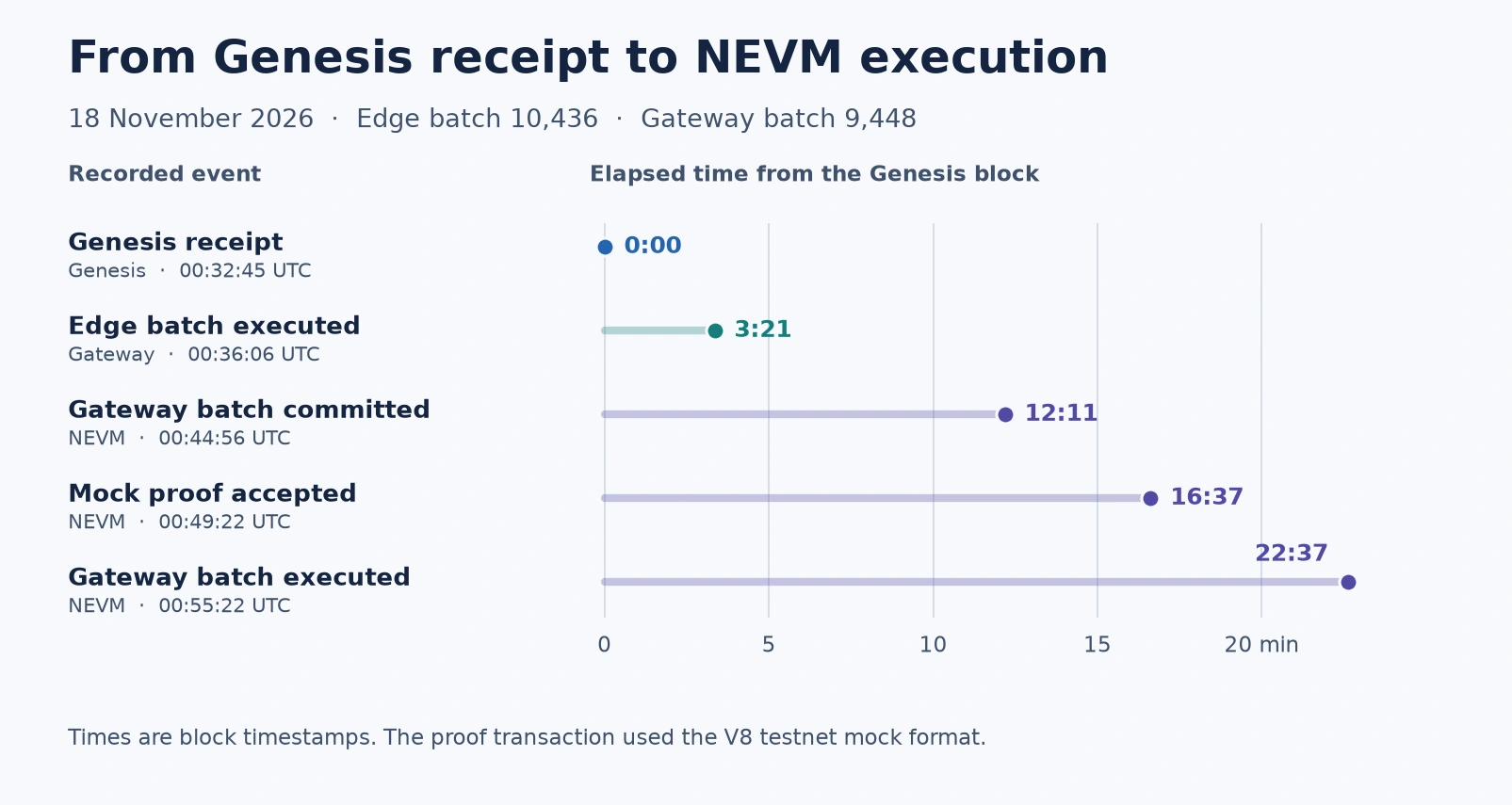
The five blocks span 22 minutes 37 seconds. These timestamps describe one testnet transaction and include waiting between blocks. Measuring real proving time requires a batch that runs the production proof path and timing from its workers. Full-size timing chart · V8 proof formats
Reproduce the first link with curl and jq. Replace tx_hash to follow another mined transaction on the same deployment. The Ethereum receipt encodes its block number in hex. The zkSYS batch method takes that height as a JSON integer.
zk_rpc=https://rpc-zk.tanenbaum.io
tx_hash=0xa018d61db50752eeda10c6d52b51fd1741cc8eb41db46d9b972677539d5fef0b

block_hex=$(jq -nc --arg tx "$tx_hash" \
  '{jsonrpc:"2.0",id:1,method:"eth_getTransactionReceipt",params:[$tx]}' | \
  curl -fsS "$zk_rpc" -H 'content-type: application/json' --data-binary @- | \
  jq -er '.result.blockNumber')
block_number=$(printf '%d' "$block_hex")

jq -nc --argjson block "$block_number" \
  '{jsonrpc:"2.0",id:1,method:"zks_getBatchByBlockNumber",params:[$block]}' | \
  curl -fsS "$zk_rpc" -H 'content-type: application/json' --data-binary @- | \
  jq '{error, batch: .result.batch_info.batch_number, range: .result.block_range,
       state: .result.batch_info.state_commitment, commitment: .result.batch_info.commitment,
       settlementBlock: .result.execute_sl_block_number}'
In the event logs, each indexed value occupies a 32-byte topic. For BlockExecution the first topic identifies the event, followed by the batch number, state commitment, and batch commitment. For ReportCommittedBatchRangeZKsyncOS the three values are the batch number, first block, and last block. Match the emitting settlement contract as well as the values. Checking Core blob availability and destination withdrawal execution requires their respective records. Event ABI · Batch watcher
Reproduce the proof-format check with Foundry Cast
Read the original transaction input. Decode the outer call, remove the one-byte encoding version 0x01, then decode the previous batch, the new batch array and the submitted proof words. Outer and inner ABI · Stored batch tuple · Versioned encoding
prove_tx=0xc82091801f6b0947db4bed5fb2400e07313e2730b0c37d389d2b3c5dba9fdde0
input=$(cast tx "$prove_tx" input --rpc-url https://rpc.tanenbaum.io)
inner=$(cast decode-calldata --json 'proveBatchesSharedBridge(address,uint256,uint256,bytes)' "$input" | \
  jq -er '.[3] | select(startswith("0x01")) | "0x" + .[4:]')
stored='(uint64,bytes32,uint64,uint256,bytes32,bytes32,bytes32,uint256,bytes32)'
cast abi-decode --input --json "proofPayload(${stored},${stored}[],uint256[])" "$inner" | \
  jq '{previous: .[0][0], batch: .[1][0][0], words: (.[2]|length), prefix: .[2][:3]}'
The decoded batches are 9,447 → 9,448, with four proof words. The first three are 2051, 0, 13. The first word is 0x803, which selects verifier version 8 and proof type 3. The fourth word matches the folded public input computed from the previous and new state commitments, Gateway’s chain configuration and the batch commitment. This establishes that the sampled Gateway-to-NEVM submission used the test format that checks this binding. The real V8 format uses type 2 and carries 44 cryptographic proof words after the two routing words. Type and sizes · Public input calculation · Mock and real encodings
Inspect issuance and gas credit
Use these Foundry Cast commands on a zkSYS deployment that publishes validated build and contract addresses. Set zk_rpc to its RPC and token, issuer, tank, vault, and account to the corresponding 0x-prefixed addresses. Check the chain ID against the deployment record and confirm that the contracts exist. For an upgradeable contract, also check the proxy implementation and authority against that record. A testnet chain ID alone cannot establish that issuance or gas payment is configured.
cast chain-id --rpc-url "$zk_rpc"
block=$(cast block-number --rpc-url "$zk_rpc")
cast code "$tank" --rpc-url "$zk_rpc" --block "$block"
cast call "$tank" 'token()(address)' --rpc-url "$zk_rpc" --block "$block"
cast call "$issuer" 'token()(address)' --rpc-url "$zk_rpc" --block "$block"
Both token() calls should match the verified token address on that chain. Inspect the issuance clock and the account's reward and stake records at the same block height. These are distinct balances. pendingRewards returns legacy or passive reward accounting. A service-enabled deployment exposes per-period bonuses separately through pendingServiceRewards(address,uint256). Issuer views · Staking vault
cast call "$issuer" 'startTime()(uint256)' --rpc-url "$zk_rpc" --block "$block"
cast call "$issuer" 'currentPeriod()(uint256)' --rpc-url "$zk_rpc" --block "$block"
cast call "$issuer" 'pendingRewards(address)(uint256)' "$account" --rpc-url "$zk_rpc" --block "$block"
cast call "$vault" 'stakeOf(address)(uint256)' "$account" --rpc-url "$zk_rpc" --block "$block"
Check credit, backing, and the native SYS balance separately. The tank's zkSYS token balance should be at least its totalCredits. The surplus() view is clamped to zero, so it cannot diagnose a shortfall by itself. The native balance check remains relevant when sending ordinary transactions with tank credit. Tank accounting · Native validation
cast call "$tank" 'creditOf(address)(uint256)' "$account" --rpc-url "$zk_rpc" --block "$block"
cast call "$tank" 'totalCredits()(uint256)' --rpc-url "$zk_rpc" --block "$block"
cast call "$token" 'balanceOf(address)(uint256)' "$tank" --rpc-url "$zk_rpc" --block "$block"
cast balance "$account" --rpc-url "$zk_rpc" --block "$block"
Read a Core blob
Use syscoin-cli against your selected Core node. The node must be on the network that published the blob. Inspect the help for the release you run. Set digest to the 64 hexadecimal characters returned as versionhash, without a 0x prefix or BLAKE2s version byte.
syscoin-cli help listnevmblobdata
syscoin-cli help getnevmblobdata
syscoin-cli listnevmblobdata 10 0
syscoin-cli getnevmblobdata "$digest" false
The metadata response includes versionhash, txid, mtp, and datasize. It can include the active block height, blockhash, and chainlock when Core can locate the publication and report its ChainLock state. Use the publication's block and configured policy to evaluate confirmations. Listing or retrieving a blob does not establish finality. Core blob lookup and response · Core list help
For a blob recorded as BLAKE2s, retrieve its bytes and check the digest locally. This example uses Python's BLAKE2s implementation. Use a Keccak-256 implementation for legacy blobs.
set -o pipefail
syscoin-cli getnevmblobdata "$digest" true | \
  python3 -c 'import hashlib, json, sys
payload = bytes.fromhex(json.load(sys.stdin)["data"])
expected = sys.argv[1].lower()
actual = hashlib.blake2s(payload).hexdigest()
if actual != expected:
    raise SystemExit(f"Digest mismatch: {actual}")
print(actual)' "$digest"
If Core no longer serves the blob, query the archive provided by your deployment and verify its returned bytes. Keep the original publication locator alongside the digest and raw payload for audit and recovery. Core's query window can expire even though an application still needs replay data. Retention and integrity
Check NEVM registration
Use the NEVM JSON-RPC endpoint for your deployment. Set nevm_rpc to that endpoint and digest as above. 0x0000000000000000000000000000000000000063 is the Syscoin DA membership precompile. In the paired sysgeth code, a member is returned as the exact digest. An empty successful response is 0x. Treat RPC errors as unavailable observations.
jq -nc --arg data "0x$digest" \
  '{jsonrpc:"2.0",id:1,method:"eth_call",params:[{
     to:"0x0000000000000000000000000000000000000063",data:$data
   },"latest"]}' | \
  curl --fail --silent --show-error "$nevm_rpc" \
    -H 'content-type: application/json' --data-binary @- | jq .
The call reads sysgeth’s current 50,001-block canonical membership window. Passing an older block number to eth_call selects historical EVM state, while 0x63 still reads the current index. Retry if sysgeth reports that its metadata changed during the call. To establish a publication’s original inclusion and finality, verify the transaction in its Core block and apply your deployment’s finality policy. To inspect its contents, retrieve and hash the blob. NEVM precompile · Membership window · Retry and historical reads